
Eating Our Cake: A Critique of Food-Price Discourse in Canada
We need to talk about affordability. But we also need to talk about social costs.
Rising food prices, increasing food insecurity, and high concentration in the food supply chain have led many to call for the Canadian government to lower consumer prices by capping seller margins or promoting competition. What these discussions miss is that food production involves negative environmental externalities which create social costs – including climate-related risks to long-term food affordability.
The true cost of food production is higher than the private cost to producers. Consequently, rather than ‘inflating’ prices, existing markups on high-emissions items may be increasing the accuracy of price signals and limiting the output of external costs, thereby mimicking the effects of GHG pricing. Significantly reducing these markups would be counterproductive to allocative efficiency and long-term food affordability. Participants in food-price discourse should recognize that not all marked-up prices are ‘too high.’
Background: Affordability, Food Security, and Food Price Discourse
Affordability has been a key issue in Canadian politics through the 2020s. Rising food prices are one component of the affordability crisis. Since mid-2022, cumulative food inflation has remained above overall inflation and wage growth (Statistics Canada “Affordability” Chart 2). October 2025 saw a year-over-year food inflation rate of 3.4%, although prices did fall 0.6% from September levels (Statistics Canada “CPI October”). Predictably, data up to 2023 shows a continuous increase in food insecurity over the three preceding years, bringing the overall national rate to 25.5% (Statistics Canada “CIS”). These trends have drawn regular though not sustained attention.
Many in media (e.g., Morrone, Noakes, Soberman), civil society (e.g., Beltran et al., Food Banks Canada), and across the political spectrum in the House of Commons (e.g., Freeland (Tunney), MacGregor (House of Commons 169), Poilievre), have implied or stated that grocery prices should be lower, especially for “essential” or “staple” foods. Most propose lowering grocery prices by reducing market power-induced distortions through regulated margin caps (e.g., Freeland, MacGregor) or increased competition in the grocery sector (e.g., MacGregor, Noakes, Soberman). Proposals focus on increasing consumer affordability: there is little (if any) discussion of the social costs of different food items.
With a quarter of Canada’s population experiencing food insecurity, a policy response is clearly needed. But food is costly, in terms of inputs, water use, land use, and emissions. Our prices should reflect the true costs of food.
The Case for High Prices (Or, How Markups Mimic GHG Pricing)
The private cost of food production reflects the market price of inputs, but does not capture negative environmental externalities associated with agriculture - notably greenhouse gas (GHG) emissions. As such, the true cost of food is surely higher than the private cost to producers. From this fact follow two related but distinct arguments for allowing market concentration which enables high prices to persist. One is concerned with allocative efficiency, and one is concerned with long-term food affordability (and security).
As I will illustrate below with a case study, the fact that social costs are greater than private costs implies that bringing prices more in line with production costs through policy would – at some point – generate inefficiently low prices. These prices would send false signals to consumers, reducing the optimality of their decisions.
More tangibly, the fact that private costs are lower than current prices implies that output in the status quo is limited by the marginal cost-revenue calculations of profit-maximizing firms. As I will explain in a later section, any measure designed to lower prices would prompt firms to increase output, including output of emissions. Elevated emissions would contribute to climate change, which reduces agricultural productivity and thereby harms future food affordability.
Thus, existing price distortions in the food supply chain may mimic GHG pricing by limiting output and creating price signals which improve allocative efficiency. Given the current political unviability of GHG pricing, leaving markups on high-emissions items alone would be a low-effort way to create a second-best outcome which is more allocatively efficient and less detrimental to future affordability than the competitive equilibrium. Thus, existing distortions could provide a jerry-rigged scaffold for a better-organized food system. Policymakers should weigh these positive impacts against the negative impacts of market concentration and high consumer prices before declaring that prices are ‘too high.’
Case Study: How Markups Promote Allocative Efficiency for Beef in Canada
Beef has been a noted contributor to grocery inflation in 2025 (e.g., Statistics Canada “CPI April,” “CPI August,” “CPI September”) and is a key food for many Canadians. Processing and sales are highly concentrated: 95% of beef is processed by JBS and Cargill (Food Policy for Canada), and 81.5% of the grocery sector is controlled by Loblaws, Sobeys, Walmart, and Metro (Gaucher-Holm et al. 6). But beef is also by far the highest-emitting protein source on average (Poore and Nemecek 988). As such, it is well-suited to illustrate how high markups can create allocatively efficient prices for “staple” foods with concentrated supply chains which are becoming increasingly expensive.
GHG Emissions Cost
The following table summarizes GHG emissions per kilogram for Canadian beef production:
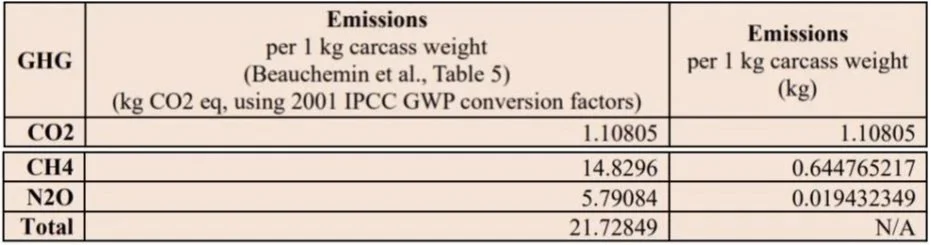
It should be noted that these estimates exclude processing and transportation, and reflect emissions intensities per unit produced, not per unit consumed. Aboagye et al. estimate that the “cradle to plate” emissions of beef in Western Canada total 32.8 kg CO2 eq. However, this study does not provide a detailed breakdown of the emissions profile for all stages, which is needed to properly calculate the social cost.
Using the Government of Canada’s 2025 prices for the social cost of each type of greenhouse gas emissions, these emissions have the following costs:
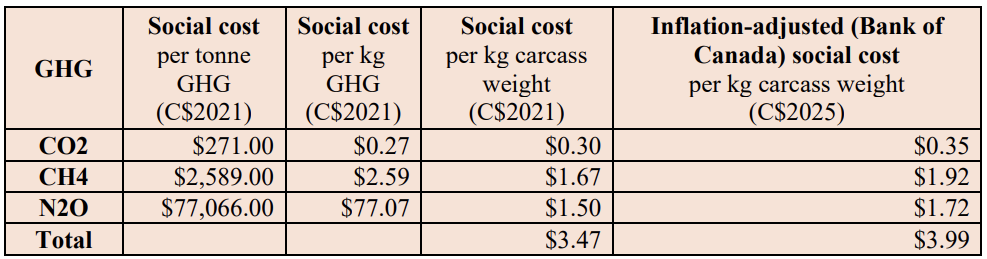
This inflation-adjusted cost of $3.99 is a negative externality.
Markup
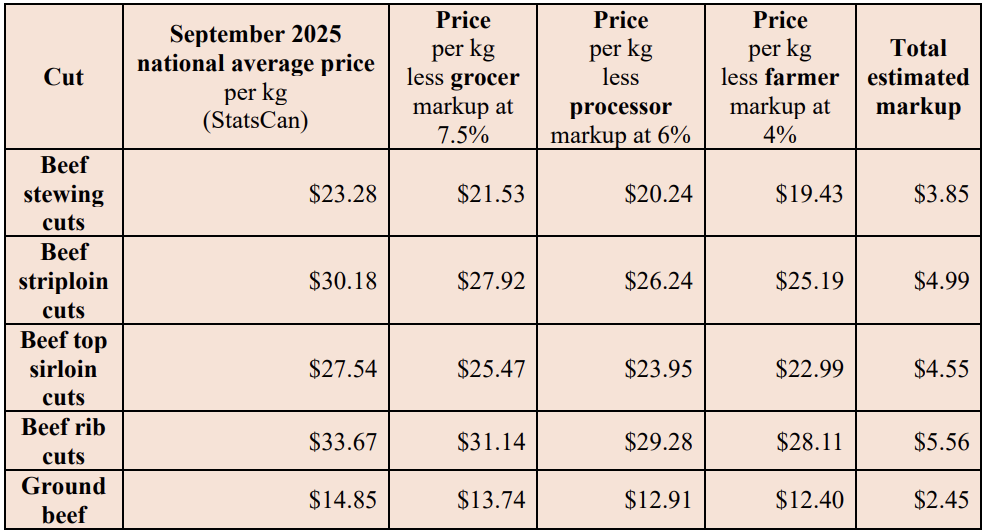
To estimate the average markup on a kilogram of beef, I have begun with data on the average price for several cuts in September 2025 (Statistics Canada “Prices”). I have then subtracted an estimated margin at each key stage (consumer sale, processing, and farming). Owing to a lack of data availability, I have used proxies to estimate these margins.
The estimated farming margin used is 4%, the average reported operational profit margin across all beef farms in 2022 (Statistics Canada “Farm”). Note that the operational margin is calculated before taxes, interest, and other financial expenses are deducted from revenue, so this figure overestimates the average net profitability (or “bottom line”) of a beef farm. I have used this figure because it captures the entire sector, and should be reasonably close to the net profit for this stage of the supply chain.
For other stages, similar sector-wide data is not available from Statistics Canada. Instead, I have used reported annual net profit margin for processor JBS (6% (Irigoyen)) and the average net profit margin for meat markets with a revenue range of C$5M-30M (7.5% (ISED Canada)) as proxies.
JBS is an Alberta-based processor which is certified only for cattle slaughter and processing of red meat, meaning beef processing likely contributes the bulk of its revenues and costs. As previously mentioned, JBS and Cargill together process 95% of Canada’s beef. Consequently, JBS’ margins are likely a good proxy for the margin on beef processing in Canada.
In 2012, 80% of beef sales occurred in the four largest grocery retailers (CAPI qtd. in Food Policy for Canada), meaning specialty meat markets must account for a small proportion. However, Statistics Canada does not publish industry-wide data on grocer margins, as it does for farms. Even were such data available, the aggregate margin on all products sold would not tell us very much about the margin on beef. While meat markets do not provide granular data on beef margins, they do provide data on meat margins, which is close. Consequently, data on meat markets is the best available proxy for average beef margins – though a highly imperfect one.
Using these values, the estimated markups are as follows:
Comparison and Implications
As the tables above illustrate, the estimated markup on beef is proximate to the estimated negative externality generated by on-farm emissions. This means the distortions introduced by markups mimic the consumer price effects of an emissions pricing regime in line with the Government of Canada’s estimated social costs for different greenhouse gases. The marked-up equilibrium in the grocery market for beef is therefore proximate to the allocatively efficient equilibrium.
This result – that the markup promotes an allocatively efficient outcome – would hold for all food items with a markup which roughly matches their external costs (i.e., both high, both low, or both in between to a similar degree). That said, beef is noted for its high emissions intensity, high recent price inflation, and high supply chain concentration, so the externality (and possibly the markup) is likely to be somewhat lower for other goods.
Consequences for Long-Term Affordability of Reducing Prices Today
Reducing markups which approximate emissions costs would immediately hurt allocative efficiency. All else equal, this is undesirable. However, policymakers may reasonably choose to sacrifice efficiency for other concerns, like fairness. Considering current food access challenges along with the economic and distributional costs of market concentration, it may seem obviously ill-judged to preserve the market structure which keeps food prices high for the sake of allocative efficiency. But lowering food prices does not just reduce allocative efficiency: it sacrifices future affordability, which will ultimately hurt the same groups struggling with affordability today.
Any measure designed to reduce prices today would involve raising output of goods and emissions, contributing to worsening climate change and hurting long-term food affordability. As prices fall towards marginal cost of production, the profit-maximizing output level typically increases; hence, firms – competitive or oligopolistic – would increase output in response. Increasing output would increase associated emissions and contribute to worsening climate change. Through drought, weather shocks, and other phenomena, climate change reduces crop yields and increases livestock input scarcity (University of Calgary), leading to reduced food supply and elevated prices.
As a solution to affordability concerns, reducing markups on high-emissions items is shortsighted and counterproductive in the long-term. There are alternative policies – such as increasing disposable income at the bottom end of the distribution or targeting the prices of nutritional substitutes with genuinely inefficient markups – which would address present food insecurity and affordability concerns without similar long-term costs. However, in order to develop better-targeted policies like this, participants in food-price discourse need to acknowledge that there are some items – like beef – whose current prices are not ‘too high.’
A Final Note on GHG Pricing (a Preferable but Impracticable Alternative)
Compared with supplier markups, explicit GHG pricing remains preferable as a means of introducing emissions costs into consumer prices for many reasons. First, GHG pricing directly targets emissions and produces more accurate price signals. Markups and social emissions costs only align by coincidence, and may align poorly. Second, tying prices to emissions incentivizes producers to price-compete by reducing the emissions-intensity of production, which promotes sustainability in food production. Third, existing markups depend on market concentration, which may generate such adverse economic effects as low prices for suppliers, wage stagnation (Food Policy for Canada), and reduced innovation.
Finally, supplier markups have redistributive effects which benefit firms at the expense of the public, and disproportionately at the expense of lower-income households. Unlike supplier markups, GHG pricing administered by government generates revenue which can be redistributed (through rebates or investment) to the public, and need not reduce welfare for most people. By contrast, when markups act as a de facto GHG price, they transfer value to firms rather than the public, leaving most consumers worse off. In the case of food, this effect is regressive, because food makes up a larger proportion of spending for lower-income households (Statistics Canada “Spending”). In the context of the affordability crisis and high rates of food insecurity, this effect is particularly problematic.
However, federal and provincial governments have recently backtracked on GHG pricing, and many Canadian voters have made it clear that they do not have the political appetite for it, especially when it raises their bills. This leaves an explicit GHG pricing regime unlikely and potentially unviable. Supplier markups are not an ideal means of correcting market failures, but they may be the best available option in this case.
In Conclusion
As outlined above, there are reasons other than affordability to support reducing market concentration in our food system. But these reasons should be weighed against the considerations of long-term affordability and allocative efficiency presented here. In the absence of policy instruments which directly capture the environmental externalities on food production, markups can mimic GHG pricing by limiting output of high-emission foods and increasing allocative efficiency. Policymakers, stakeholders, and observers concerned about affordability should recognize that not all prices are ‘too high,’ and that markups are not always purely negative things. Social costs need to enter the conversation.
Works Cited
Aboagye, Isaac A., et al. “An assessment of the environmental sustainability of beef production in Canada.” Canadian Science Publishing, 2024. Canadian Science Publishing, https://cdnsciencepub.com/doi/full/10.1139/cjas-2023-0077. Accessed 20 November 2025.
Bank of Canada. “Inflation Calculator.” Bank of Canada, https://www.bankofcanada.ca/rates/related/inflation-calculator/. Accessed 20 November 2025.
Beauchemin, Karen A., et al. “Life cycle assessment of greenhouse gas emissions from beef production in western Canada: A case study.” Agricultural Systems, vol. 103, no. 6, 2010, pp. 371-379. Science Direct, https://www.sciencedirect.com/science/article/pii/S0308521X10000387?casa_token=Q6nyGjo0UQAAAAA:xrV3EvZyVOn5eTHb_L_FieT14FwV4F_rP1qQbfMB9oM6i4IkH 7wfpg7kM4vdpV1WKN8lI_TAqEI. Accessed 20 November 2025.
Beltran, Jimy, et al. Should Canada Retain Dairy Supply Management Over the Long Term. Max Bell School of Public Policy, 28 July 2023, https://www.mcgill.ca/maxbellschool/policylab-2023/dairy. Accessed 20 November 2025.
Food Banks Canada. Report Card. Food Banks Canada, 2025, https://foodbankscanada.ca/poverty-report-card/report-card/?y=2025&p=canada. Accessed 20 November 2025.
Gaucher-Holm, Alexa, et al. “The structure of the Canadian packaged food and non-alcoholic beverage manufacturing and grocery retailing sectors through a public health lens.” Globalization and Health, vol. 19, 2023. BMC, https://globalizationandhealth.biomedcentral.com/articles/10.1186/s12992-023-00917-w. Accessed 20 November 2025.
House of Commons of Canada. Order Paper and Notice Paper No. 324 - 44-1. 4 June 2024. OurCommons, https://www.ourcommons.ca/Content/House/441/NoticeOrder/324/ordpaper324.PDF. Accessed 20 November 2025.
Innovation, Science and Economic Development Canada. “Report for: NAICS 44524 - Meat markets - Financial Performance Data.” Financial Performance Data, Government of Canada, 19 August 2025, https://ised-isde.canada.ca/app/ixb/fpd-dpf/report. Accessed 22 November 2025.
Irigoyen, Federico. Meat, Beef & Poultry Processing in Canada. August 2025. IBISWorld, IBISWorld, https://www.ibisworld.com/canada/industry/meat-beef-poultryprocessing/251/. Accessed 18 October 2025.
MacRae, R.J. “Corporate concentration.” Food Policy for Canada: joined up food policy to create a just, health promoting and sustainable food system, York University, https://foodpolicyforcanada.info.yorku.ca/backgrounder/problems/corporateconcentration/. Accessed 20 November 2025.
Morrone, Zoey. “17 Grocery Items Canadians Are Paying Way Too Much For.” Trendonomist, 30 September 2025, https://trendonomist.com/17-grocery-items-canadians-are-paying-waytoo-much-for/. Accessed 20 November 2025.
Noakes, Taylor C. “Canada needs to break up grocery monopolies.” CULTMTL, 12 June 2025, https://cultmtl.com/2025/06/canada-needs-to-curb-corporate-greed-and-break-upgrocery-monopolies/. Accessed 20 November 2025.
Poilievre, Pierre. LIVE: Stop Taxing Groceries. 29 September 2025. YouTube, https://www.youtube.com/watch?v=hab-MWmCNMg. Accessed 28 November 2025.
Poore, J., and T. Nemecek. “Reducing food's environmental impacts through producers and consumers.” Science, vol. 360, 2018, pp. 987-992. Science, https://www.science.org/doi/10.1126/science.aaq0216. Accessed 20 November 2025.
Soberman, David. “What high grocery prices say about the dysfunction in Canada's economy.” The Globe and Mail, 30 September 2024, https://www.theglobeandmail.com/business/commentary/article-what-high-groceryprices-say-about-the-dysfunction-in-canadas-economy/. Accessed 20 November 2025.
Statistics Canada. “The Daily — Canadian Income Survey, 2023.” Statistics Canada, 1 May 2025, https://www150.statcan.gc.ca/n1/daily-quotidien/250501/dq250501b-eng.htm. Accessed 21 November 2025.
Statistics Canada. “The Daily — Consumer Price Index, April 2025.” Statistics Canada, 20 May 2025, https://www150.statcan.gc.ca/n1/daily-quotidien/250520/dq250520a-eng.htm. Accessed 21 November 2025.
Statistics Canada. “The Daily — Consumer Price Index, August 2025.” Statistics Canada, 16 September 2025, https://www150.statcan.gc.ca/n1/daily-quotidien/250916/dq250916aeng.htm. Accessed 21 November 2025.
Statistics Canada. “The Daily — Consumer Price Index, October 2025.” Statistics Canada, 17 November 2025, https://www150.statcan.gc.ca/n1/daily-quotidien/251117/dq251117aeng.htm. Accessed 21 November 2025.
Statistics Canada. “The Daily — Consumer Price Index, September 2025.” Statistics Canada, 21 October 2025, https://www150.statcan.gc.ca/n1/daily-quotidien/251021/dq251021aeng.htm. Accessed 21 November 2025.
Statistics Canada. “The Daily — Farm operating revenues and expenses, 2022.” Statistics Canada, 28 March 2024, https://www150.statcan.gc.ca/n1/dailyquotidien/240328/dq240328d-eng.htm. Accessed 21 November 2025.
Statistics Canada. “Household spending by household income quintile, Canada, regions and provinces.” Statistics Canada, 21 May 2025, https://www150.statcan.gc.ca/t1/tbl1/en/cv.action?pid=1110022301. Accessed 20 November 2025.
Statistics Canada. “Research to Insights: Perspectives on Affordability and Inequality.” Statistics Canada, 22 January 2025, https://www150.statcan.gc.ca/n1/pub/11-631-x/11-631- x2025001-eng.htm. Accessed 20 November 2025.
Tunney, Catharine. “Chrystia Freeland promises tax cut, plan for cheaper groceries if elected Liberal leader.” CBC, 11 February 2025, https://www.cbc.ca/news/politics/freelandincome-tax-groceries-1.7456130. Accessed 20 November 2025.
University of Calgary. “How does climate change affect farming?” University of Calgary Office of Institutional Commitments - Sustainability, https://www.ucalgary.ca/sustainability/mobilizing-alberta/climate-action-blogs/how-doesclimate-change-affect-farming. Accessed 28 November 2025.